India achieved a record ~27 GW of solar capacity addition in the first half
of 2026, pushing cumulative solar installations past 160 GW and contributing
to total renewable capacity of around 288 GW. A substantial energy storage
pipeline—tens of GWh already tendered and growing rapidly—underscores the
country’s ambition to become a global clean energy manufacturing powerhouse.
Yet this deployment success masks a structural weakness: critically low
investment in indigenous R&D.
Heavy dependence on imported technology and components risks undermining
long-term cost competitiveness and supply chain resilience for domestic EPCs
and solar panel manufacturers. Without a decisive shift toward
funding and developing local solar modules, advanced cells, inverters, and
battery chemistries, India risks remaining an assembly hub rather than an
innovation leader.
Background and Context
The Indian renewable energy sector is expanding at an unprecedented pace.
Official and industry data confirm solar additions of 26–27 GW in H1 2026
(a 43–50% year-on-year jump), driven by utility-scale projects, a sharp rise
in rooftop solar under schemes such as PM Surya Ghar, and accelerating
hybrid/storage tenders. Gujarat, Rajasthan, and Tamil Nadu led installations.
Policy tools—including the Production Linked Incentive (PLI) scheme, the
Approved List of Models and Manufacturers (ALMM) for modules and cells,
basic customs duties, and domestic content requirements—have rapidly scaled
module manufacturing capacity to over 200 GW. Cell capacity has also grown,
though it lags modules significantly, while ingot, wafer, and polysilicon
production remain minimal.
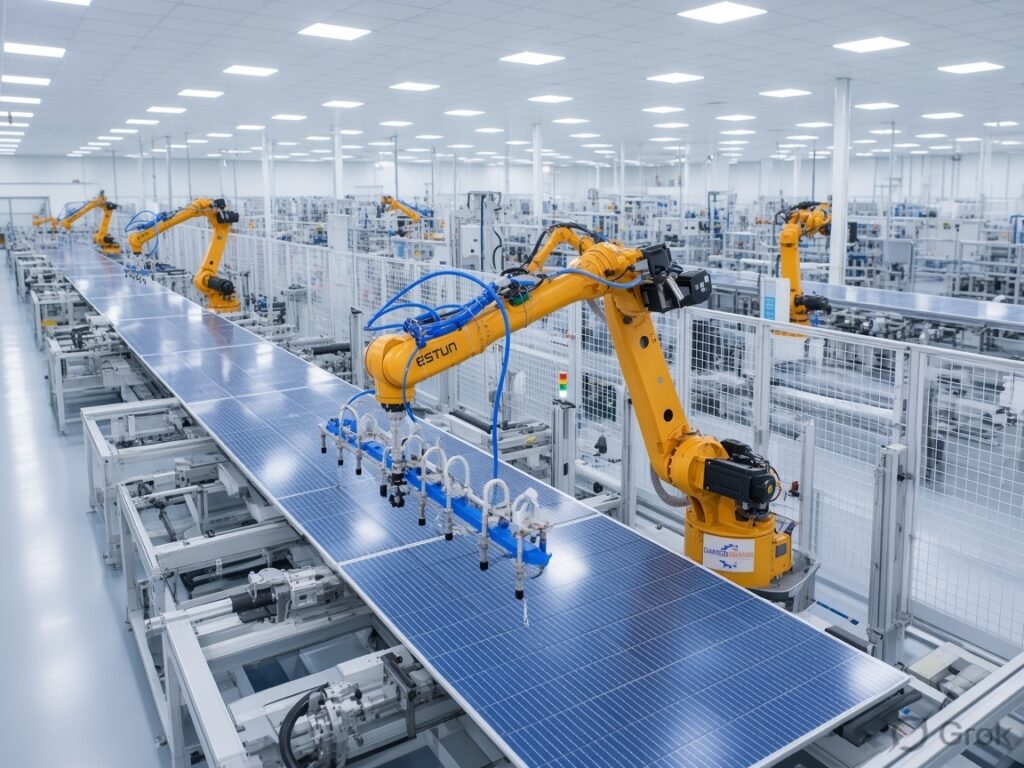
This imbalance leaves solar panel manufacturers heavily
reliant on imported upstream materials, equipment, and intellectual property,
primarily from China.
Public R&D spending in renewables has historically been modest (on the
order of tens of crores annually through MNRE channels in earlier years),
while domestic manufacturers typically allocate around 0.1% of revenue to
R&D—far below the 2–6% common among leading Chinese peers.
India holds only a few hundred solar-related patents compared with tens of
thousands in China. The result is a technology gap in high-efficiency cells
(TOPCon, HJT, back-contact, emerging tandem/perovskite) and process know-how.
Key Challenges for Solar Panel Manufacturers
While capacity addition creates immediate demand, the technological
foundation remains imported. Solar panel manufacturers
excel at scaling assembly lines under ALMM and PLI support, yet face several
structural challenges:
-
Upstream vulnerability:
Near-total import dependence for polysilicon, wafers, and much of the
cell technology and capital equipment. -
Cost and efficiency pressures:
Domestic modules and cells often carry a premium versus imports, and
Indian players must continuously license or reverse-engineer foreign
process improvements to stay competitive. -
Overcapacity risk at the module level:
Utilization rates have been reported in the 35–40% range in some
analyses, while cell and especially wafer capacity trail far behind. -
Limited innovation ecosystem:
Weak industry-academia linkages, insufficient pilot-scale facilities,
and low private R&D spend hinder commercialization of next-generation
technologies.
Without stronger indigenous R&D, the sector risks
locking into older technology generations while global leaders move ahead.
Supply-chain shocks, duty fluctuations, and currency movements continue to
affect project economics for both manufacturers and developers.
What This Means for EPCs and Developers
For EPC contractors and solar developers the picture is mixed. Record
capacity addition delivers high volumes of work and supports India’s
500 GW non-fossil target trajectory. At the same time, reliance on foreign
technology and components exposes projects to global disruptions,
import-duty volatility, and higher costs for proprietary high-efficiency
products.
EPCs that prioritize partnerships with quality-focused domestic
solar panel manufacturers, push for greater localization,
and incorporate storage solutions will be better positioned.
Companies active in design, installation, and system integration—such as
those profiled on platforms like Kalpa Power—illustrate how localized
expertise in solar power systems can help end customers reduce energy costs
while navigating the evolving policy and supply landscape.
Greater domestic technological depth would improve supply-chain resilience,
stabilize pricing, and support higher domestic value addition—benefits that
flow through to project bankability and long-term asset performance.
The Path Forward: Policy and Industry Pivot
The industry must move beyond a pure “deployment-at-all-costs” mindset
toward technological sovereignty. Expected and needed steps include:
-
Stronger incentives or mandates for domestic R&D:
Including R&D credits, capital support for pilot lines, and
industry-academia collaboration platforms. -
Targeted upstream incentives:
Capex support rather than purely sales-linked incentives for wafers,
ingots, and polysilicon to close the value-chain gap. -
Continued refinement of ALMM and PLI frameworks:
Rewarding efficiency, reliability, and genuine local IP rather than
assembly alone. -
Skills development and testing infrastructure:
Building capabilities so manufacturers can handle more advanced
manufacturing processes and technologies.
As India scales infrastructure toward net-zero goals, the ultimate
determinant of sustained success will be the ability of
solar panel manufacturers and the broader ecosystem to
develop and deploy cutting-edge indigenous technology.
Only then can the country secure both energy security and economic
self-reliance while remaining cost-competitive globally.
Key Takeaways for Stakeholders
Watch for future government measures that explicitly boost
indigenous R&D and domestic value addition.
Solar panel manufacturers that invest early in process innovation,
upstream integration, and quality will capture durable advantages.
EPCs and developers should factor technology origin and supply-chain
depth into procurement strategies today.
India’s clean-energy manufacturing story is impressive on volume.
Closing the R&D gap will determine whether that story becomes one of
true global leadership.