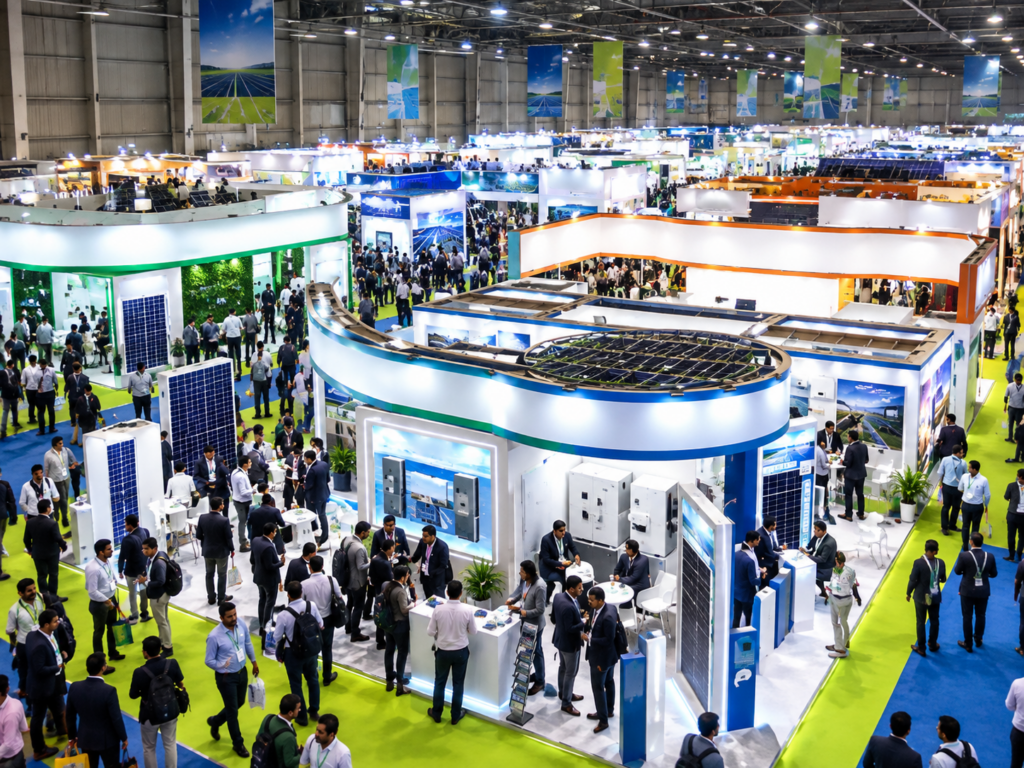
An exhibition stall can attract attention. But a well-planned exhibition marketing strategy can turn that attention into business opportunities.
Renewable energy exhibitions bring together solar manufacturers, EPC companies, distributors, technology providers, project developers and industry decision-makers. These events create valuable opportunities to showcase products, build relationships and explore new partnerships. However, simply participating in an exhibition does not guarantee qualified leads or business growth.
For many companies, success is measured by visitor footfall, brochures distributed and visiting cards collected. The more important question is how many of those interactions lead to meaningful conversations, qualified enquiries and future business.
Successful solar exhibition marketing goes beyond visibility. It connects pre-event promotion, impactful stall branding, engaging demonstrations, digital lead capture and strategic follow-ups into one continuous marketing journey.
Here is how renewable energy businesses can transform their next exhibition into a more effective B2B lead generation opportunity.
1. Build Anticipation Before the Exhibition Begins
Exhibition marketing should start weeks before the event, not when your stall opens. Waiting for visitors to discover your brand organically can mean missing opportunities to connect with potential buyers before they arrive at the venue.
A structured pre-exhibition marketing campaign helps your company build awareness, communicate its value proposition and encourage relevant visitors to schedule meetings with your team.
Pre-exhibition marketing strategies
- Announce your participation: Publish LinkedIn posts, website updates, email announcements and exhibition countdown creatives.
- Reach the right audience: Connect with solar EPCs, distributors, dealers, project developers, procurement teams and prospective business partners.
- Schedule meetings in advance: Use personalised invitations and relevant outreach to arrange conversations before the exhibition begins.
- Promote product launches: Give your audience a reason to visit by highlighting new products, technical demonstrations and key business announcements.
- Create an exhibition landing page: Share stall details, product information, demonstration schedules and a meeting-booking or enquiry form.
- Use targeted digital campaigns: Where appropriate, run relevant advertising campaigns to increase awareness among your intended business audience.
How AI can improve pre-event marketing
AI-assisted tools can help marketing teams research target accounts, develop audience-specific messaging, create content variations and organise outreach campaigns. One product announcement can be adapted into a LinkedIn post, email invitation, short video script and exhibition countdown creative.
For example, a solar module manufacturer can develop different communication for EPC companies, distributors and project developers, ensuring that each audience receives information relevant to its needs. Human review remains essential to verify product claims and maintain authentic communication.
The goal: Make the right people aware of your brand before they enter the exhibition hall.
2. Design an Exhibition Stall That Communicates Your Value
Your exhibition stall is a physical representation of your brand, products and capabilities. In a crowded exhibition hall, visitors make quick decisions about where to stop and which companies deserve their attention.
Effective exhibition stall design combines visual appeal with clear communication. Visitors should understand what your company offers, who it serves and why they should engage with you.
- Consistent brand identity: Use recognisable colours, readable typography and professional graphics.
- Clear messaging: Communicate your core value proposition without overwhelming visitors with text.
- Strategic product displays: Make important products, components and technologies easy to explore.
- Digital displays: Showcase product videos, project installations, case studies and manufacturing capabilities.
- Dedicated meeting space: Give interested visitors an environment for meaningful technical and commercial discussions.
- Clear calls to action: Encourage visitors to scan a QR code, request a catalogue or schedule a demonstration.
Remember, visibility attracts attention, but clarity creates interest. Your stall should make it easy for potential customers to understand your offering and take the next step.
3. Turn Your Exhibition Stall into an Interactive Experience
A passive display may showcase your products, but an interactive experience gives visitors a reason to stop, participate and engage with your team. This is particularly valuable in the renewable energy industry, where technical capabilities and product performance often require explanation.
Six ideas to attract and engage exhibition visitors
1. Live product demonstrations
Demonstrate how your products or technologies work. Depending on the
solution, this could include working models, monitoring systems,
inverter interfaces, energy storage demonstrations or product
walkthroughs.
2. Interactive product configurators
Use a touchscreen or tablet to let visitors explore product options,
technical specifications and indicative configurations based on
their requirements.
3. An innovation wall
Create a visual showcase of new products, project milestones,
certifications, manufacturing capabilities and technology developments.
Use concise explanations rather than dense paragraphs.
4. Expert-led mini sessions
Schedule short technical presentations throughout the event. Topics
could include installation practices, product selection, maintenance
or emerging renewable energy technologies.
5. Technical quizzes and challenges
Invite visitors to participate in a short industry-related quiz,
product identification challenge or technical knowledge activity.
Use the experience to initiate useful conversations.
6. QR-led digital experiences
Connect product displays to relevant videos, downloadable catalogues,
case studies, technical documents or demonstration-booking pages.
Separate QR codes can help distinguish engagement with different
products and campaigns.
Every attraction should have a purpose. An impressive demonstration becomes more valuable when it leads to a relevant conversation, product enquiry or scheduled meeting.
4. Convert Visitor Engagement into Qualified Leads
High footfall does not automatically translate into high-quality leads. An exhibition visitor could be a prospective customer, distributor, consultant, technology partner or someone simply exploring the industry.
Your team needs a structured way to understand these differences and identify the most relevant business opportunities.
Build a simple digital lead capture system
Instead of relying exclusively on visiting cards and handwritten notes, use a QR code or tablet-based form to capture relevant information.
- Name, company and designation
- Business category and area of interest
- Product or solution requirements
- Project stage or potential business opportunity
- Preferred next step, such as a meeting or demonstration
- Relevant consent and preferred communication channel
Keep forms short and collect only information necessary for the intended purpose. Where suitable, connect submissions to a CRM or structured lead management system so authorised team members can assign ownership and track follow-up activities.
Ask questions that start meaningful conversations
- What types of projects or customers do you serve?
- What technical or commercial challenges are you trying to solve?
- Are you exploring a new supplier, product or business partnership?
- What information would help you evaluate our solution?
- Would a product demonstration or follow-up meeting be useful?
These questions help your team understand visitor requirements, personalise the discussion and agree on a practical next step.
5. Use AI to Organise Leads and Personalise Follow-Ups
AI can support exhibition marketing beyond content creation. When incorporated into an appropriate workflow, it can help teams organise lead information, summarise meeting notes and prepare relevant follow-up communications.
- Meeting-note summaries: Turn structured notes into concise summaries of requirements and agreed next steps.
- Follow-up drafting: Prepare initial email drafts referencing the actual conversation and relevant product information.
- Lead categorisation: Help classify contacts against predefined qualification criteria, with human verification.
- Content personalisation: Prepare relevant communication for EPCs, distributors, manufacturers and project developers.
- Performance reporting: Summarise campaign and lead data to help identify useful engagement patterns.
AI should make your follow-ups more relevant and efficient—not more generic or intrusive.
For example, after meeting an EPC interested in a specific product range, your team can use an AI-assisted workflow to draft a message containing the relevant catalogue, technical information and proposed meeting. Verify the details before sending and avoid sharing confidential visitor information with unapproved AI tools.
6. Follow Up Before the Conversation Goes Cold
One of the biggest missed opportunities in exhibition marketing happens after the event. Companies invest in stalls, travel, promotional materials and team participation, but follow-up communication is often delayed or inconsistent.
A post-exhibition marketing plan should be prepared before the event begins.
A practical post-exhibition follow-up timeline
Within 24–48 hours: Organise lead records, review meeting notes and contact priority prospects according to the next steps agreed upon.
During the first week: Share relevant catalogues, technical documents, presentations or case studies. Arrange product demonstrations and commercial meetings where appropriate.
Over the following weeks: Continue relevant, permission-based communication through meetings, calls, emails and useful educational content.
Throughout the process: Record responses, assign responsibilities, track next steps and update lead status in your CRM or lead management system.
Personalise follow-ups for different audiences
- EPCs can receive relevant product specifications and technical information.
- Distributors can receive suitable channel partnership information.
- Project developers can receive relevant case studies and meeting invitations.
- Early-stage contacts can receive useful educational material where they have agreed to receive it.
The objective is not simply to contact every visitor. It is to continue the right conversations with the right people.
7. Connect Exhibition Marketing with Your Digital Presence
An exhibition should not operate as an isolated marketing activity. The most effective approach connects on-ground engagement with your website, social media, email communication, video content and sales process.
Before the event: Publish participation announcements, product previews, expert introductions and meeting invitations. Use your website and social media to explain what visitors can expect at your stall.
During the event: Share product demonstrations, technical insights, exhibition highlights and genuine team interactions, subject to appropriate permissions. Capture content that can also be used in future marketing campaigns.
After the event: Repurpose relevant exhibition footage and insights into LinkedIn posts, short videos, blogs, email content and sales presentations. Continue the conversation with interested audiences through useful, relevant communication.
This creates a connected marketing journey in which the exhibition generates content, the content supports digital visibility, and relevant engagement can lead to further business opportunities.
8. Measure What Matters Beyond Exhibition Footfall
Visitor numbers and badge scans can indicate reach, but they do not tell the complete business story. Measuring the full journey helps you understand whether your investment is generating meaningful outcomes.
- Pre-event: Relevant audience reach, invitation responses and meetings booked.
- On-site: Meaningful conversations, demonstrations and relevant QR interactions.
- Lead generation: Qualified leads, identified requirements and agreed next steps.
- Post-event: Follow-up responses, meetings held and opportunities created.
- Business outcomes: Pipeline value, conversions and attributable revenue where measurable.
Compare performance against your objectives, previous exhibitions and total campaign costs. Renewable energy purchasing decisions can involve technical evaluations, project timelines and multiple stakeholders, so not every opportunity will convert immediately.
The goal is to identify what worked, understand missed opportunities and make your next exhibition more effective.
9. Build a 360-Degree Exhibition Marketing Strategy with Sitashya
A successful renewable energy exhibition requires more than a well-designed stall. It needs coordinated planning across branding, digital promotion, content, audience engagement, lead capture and post-event communication.
Sitashya helps renewable energy businesses connect these activities through an integrated B2B marketing approach. From pre-event promotion to post-event engagement, the objective is to help your brand communicate consistently and make its exhibition participation count.
Our 360-degree exhibition marketing support
- Exhibition branding and creative designing: Stall graphics, catalogues, brochures, corporate profiles, promotional materials and supporting brand communication.
- Pre-event digital marketing: Social media campaigns, LinkedIn communication, email content, promotional videos and landing-page messaging.
- Photography and videography: Product demonstrations, leadership interviews, factory footage, exhibition coverage and promotional video production.
- Visitor engagement concepts: Creative ideas for product showcases, digital displays, QR-led experiences and demonstration communication.
- AI-assisted marketing workflows: Support for content ideation, campaign variations, lead-note organisation and follow-up drafting, with appropriate human review.
- Post-event marketing: Exhibition highlights, follow-up content, digital campaigns and structured communication to continue relevant conversations.
- B2B demand generation: Connecting exhibition activity with your wider digital presence, prospect engagement and lead generation strategy.
Whether you are a solar module manufacturer, inverter brand, EPC company, energy storage provider or renewable energy technology business, your exhibition strategy should reflect the value of your solutions and the expectations of your buyers.
Make Your Next Exhibition Count
Don't treat your exhibition as a three-day activity. Treat it as a marketing opportunity that begins before the event, creates meaningful engagement during the event and continues working after the exhibition closes.
Plan smarter. Engage better. Follow up strategically.
Partner with Sitashya to develop a 360-degree exhibition marketing approach for your renewable energy business.
Folow Us On :
Linkedin
Stay Updated On :
Whatsapp Channel
Phone / WhatsApp:
+91 88005 80606